



How Often Should I Review Precision Tool Supplier Certifications?
Review a precision tool supplier’s certifications at least annually as a practical starting point, with additional checks before certificates expire and whenever a significant supplier change occurs. For higher-risk applications, such as tooling that controls a safety-critical dimension or measurement equipment used to release product, quarterly or six-monthly status checks may be appropriate. Any contractual, customer, or applicable regulatory requirement takes priority over this suggested schedule.
An annual review alone leaves gaps. A certificate can remain within its printed validity dates while its status, scope, or covered manufacturing locations change. A useful review schedule therefore combines a planned reassessment with expiry alerts and event-triggered checks. The depth of each review should reflect what a certification failure could mean for your production, inspection, and customer obligations.
How often should I review supplier certifications after onboarding?
Use the supplier’s role and the consequences of failure to set the interval. A supplier providing standard cutting tools for noncritical work needs a different level of oversight from a supplier providing custom gauges used to accept tightly toleranced components.
The following intervals are suggested starting points for an internal policy, not universal certification rules:
- Lower-risk suppliers: Conduct a documented annual review, supported by expiry reminders and checks when relevant changes are reported. This may suit standard tools with readily available alternatives and limited consequences if performance deteriorates.
- Moderate-risk suppliers: Retain the annual full review and consider a brief status check every six months. Examples include suppliers of custom tooling whose performance affects scrap, process capability, or production continuity.
- Higher-risk suppliers: Consider quarterly status checks alongside a fuller annual reassessment. This can be appropriate where tooling or measurement services influence safety, product release, customer approval, or compliance with specified requirements.
A status check can be a focused verification of validity, scope, covered sites, and unresolved changes. A full reassessment should also examine supplier performance and whether the original approval conditions still fit the work being purchased.
Review the risk classification when the application changes. A supplier initially approved for prototype tooling may later supply production gauges. Its certificate may be unchanged, but your dependence on the supplier and the consequences of an error have increased.
If the supply agreement requires certification at every shipment or a customer specifies a particular monitoring frequency, incorporate that requirement directly into purchasing controls. A general annual policy cannot replace a more specific obligation.
Why is checking the expiry date insufficient?
The expiry date answers only part of the question. Procurement also needs to establish whether the certificate is active, applies to the supplying organization, and covers the activities and locations relevant to the order.
A supplier could present a valid certificate covering one factory while moving your tool production to another location. A distributor could provide the manufacturer’s certificate without explaining which entity performs final inspection or modification. In both situations, the document may be authentic, yet its relevance to your purchase needs further examination.
Certification scope deserves particular attention. A quality management system certificate covering the distribution of industrial tools does not establish that the supplier’s manufacturing operations fall within that scope. Likewise, a laboratory’s accreditation must be assessed against the calibration or testing activity you require, including the applicable range and capability.
Different documents also provide different kinds of assurance. A management system certificate supports confidence in specified organizational processes. Laboratory accreditation addresses competence for activities within its scope. Product certificates, inspection reports, and calibration certificates provide other forms of evidence. They should not be treated as interchangeable.
For precision tools, certification supports supplier approval, but it does not establish that a particular cutter, fixture, or gauge meets your drawing. Dimensional inspection, material evidence, acceptance criteria, and application performance remain relevant where required.
What should a certification review actually check?
Start with the certificates your organization relied on when approving the supplier. Reviewing every document a supplier holds adds work without necessarily improving assurance. Concentrate on the credentials linked to the purchased activity and your approval requirements.
A practical review should cover these points:
- Supplier identity: Match the certified legal entity to the entity fulfilling the order. Investigate differences involving trading names, affiliated companies, or subcontractors.
- Covered locations: Check the manufacturing, inspection, or service site relevant to your purchase. For multisite certification, review the relevant site listing or annex.
- Scope: Confirm that the stated activities cover the work for which certification is required.
- Validity and status: Check effective and expiry dates, then verify active status through the issuing body or an appropriate official directory where available.
- Issuing organization: Confirm the issuer’s identity and, where accredited certification is required, the relevant accreditation and scope.
- Changes since approval: Identify revisions to the certificate, covered sites, scope, ownership, and any suspension or withdrawal affecting required coverage.
A PDF supplied by the vendor is useful evidence, but it should not be the only source when independent verification is available. Use the issuing certification body’s or accreditation body’s official channels. If a directory does not show the record, seek clarification from the issuer before drawing a conclusion; directory coverage and update timing can differ.
For an accredited calibration provider, inspect the accreditation scope for the measurement being purchased. A general claim of accreditation does not establish coverage for every measurement type, range, or uncertainty needed by your inspection process.
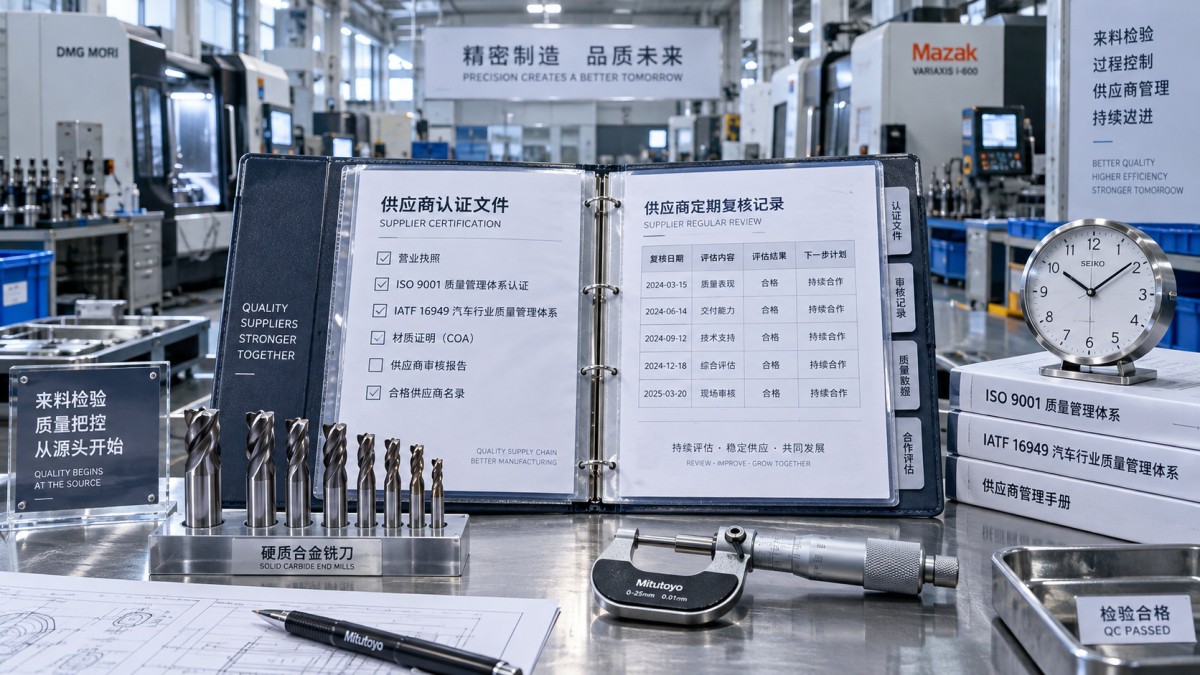
Record the verification date, source, reviewer, findings, and resulting approval decision. Save the relevant scope annexes with the certificate. This makes the review usable when another buyer places an order or when quality personnel need to reconstruct the basis for approval.
Which changes should trigger an immediate review?
Do not wait for the next scheduled review when a change could affect the certification relied on for approval. Require suppliers to notify your organization of defined events, and make those notification obligations part of the purchasing or quality agreement where appropriate.
The most useful triggers are concrete:
- A manufacturing, inspection, or calibration site moves, closes, or is replaced.
- The supplier changes its legal entity or transfers your work to an affiliate or subcontractor.
- A certificate is suspended, withdrawn, reduced in scope, or replaced with coverage that differs from the approved arrangement.
- The supplier changes a process relevant to your requirements, such as tool coating, heat treatment, final grinding, or calibration.
- Your purchase moves into a more demanding application or becomes subject to a new customer requirement.
- Repeated quality failures suggest that the controls supporting supplier approval need reassessment.
Not every ownership change or process adjustment invalidates certification. The review should establish what changed, whether the required coverage still applies, and whether your technical approval needs updating.
For example, transferring final grinding of a custom tool to another facility raises two separate questions: whether certification requirements still cover the arrangement, and whether the transferred process can meet the drawing and inspection requirements. Resolving the first question does not automatically resolve the second.
A sharp increase in dimensional rejects should also trigger a targeted review even if every certificate remains current. Check relevant corrective actions, inspection controls, and process changes alongside certification status. A valid certificate cannot explain away deteriorating performance.
When should I request renewal evidence?
Set reminders early enough to obtain and assess renewal evidence before the existing certificate expires. A reminder 60 to 90 days ahead can be a workable administrative starting point, but the lead time should reflect your purchasing cycle and the time needed to resolve a problem.
For custom tools with long manufacturing lead times, check whether the required certification will remain valid through the relevant production and delivery period. An order placed while a certificate is valid may still create an issue if the required coverage lapses before the work is completed.
Request the renewed certificate and its applicable scope documents when available. If renewal is pending, distinguish between evidence that an assessment has been scheduled and evidence that certification remains active. A planned audit or renewal application does not, by itself, establish continued validity.
Where a supplier claims an extension, confirm its basis with the issuing body. Avoid assuming that certification continues automatically while paperwork is being processed. Build enough lead time into the workflow to seek clarification, adjust an order, or arrange an alternative source if necessary.
What should I do if certification expires or is suspended?
First establish the facts: which certificate is affected, what activities and sites it covers, when the status changed, and whether that certification is a condition of your approval or contract. An expired document in your database may reflect a filing failure; an independently confirmed suspension requires a different response.
Then identify affected orders and deliveries. Quality and procurement should determine whether to pause new orders, restrict use, request additional evidence, or seek approval for a permitted exception. Where certification is mandatory under a contract or applicable requirement, extra inspection does not automatically remove that obligation.
Review supplied tools or completed services according to the nature of the concern. A certification lapse does not prove that every delivered item is defective. Equally, acceptable historical performance does not establish that current approval requirements are satisfied. The assessment should connect the reason for the lapse with the products, processes, and records potentially affected.
Any permitted temporary exception should name the affected items, acceptance conditions, responsible approver, and end date. Supporting measures might include additional dimensional verification or review of specific process records, provided those measures address the actual risk. An open-ended exception can quietly become the default purchasing arrangement.
How can procurement keep the schedule manageable?
Maintain one controlled supplier record with the required certification, applicable entity and site, scope reference, expiry date, risk level, next review date, and approval status. Assign responsibility for updating it. Procurement may collect documents, while quality or a technical evaluator judges whether the coverage is adequate.
Connect the record to purchasing decisions. A reminder email has limited value if buyers can continue ordering without seeing that a required certificate has expired or that a review remains unresolved. The appropriate control may be a visible warning, approval requirement, or purchasing restriction, depending on the obligation and risk.
Use the scheduled review to reconsider the frequency itself. Stable performance and unchanged scope may support a lighter interim check. Site transfers, repeated failures, or increased dependence may justify closer monitoring. Reducing a review interval should follow a documented risk decision.
The next review date should therefore sit beside two other controls: the certificate’s expiry date and the events that require immediate action. Together, they give buyers a clear basis for deciding whether the supplier remains approved for the particular precision tool or service being ordered.
Related News
Get weekly intelligence in your inbox.
No noise. No sponsored content. Pure intelligence.
