



What cold chain gaps affect biopharmaceuticals in Southeast Asia?
The cold chain gaps that affect biopharmaceuticals in Southeast Asia are concentrated at the connections between storage, transport, border clearance, and final delivery. A shipment may leave a qualified warehouse and travel in suitable packaging, yet lose temperature control while waiting for an airport transfer, customs release, a ferry connection, or hospital acceptance. Uneven access to refrigerated capacity, gaps in backup power, and incomplete temperature records make these transitions difficult to manage.
For project managers and engineering leads, the first judgment should be route-specific: can every stage maintain the product’s required conditions, including during a credible delay? Southeast Asia cannot be treated as one operating environment. A distribution route through a major logistics hub presents different challenges from one involving provincial facilities or inter-island transport. The practical task is to identify where protection ends, how long the next stage might take, and who can intervene before product quality is put at risk.
Cold storage capacity does not guarantee a protected route
The presence of a refrigerated warehouse or vehicle answers only part of the infrastructure question. Its operating temperature, usable capacity, recovery after door openings, maintenance condition, and loading arrangements must fit the product and shipment profile. A facility equipped for refrigerated medicines may be unsuitable for a product requiring frozen or ultra-low-temperature handling. Even products sharing a nominal storage range can have different tolerances for cumulative exposure, freezing, or repeated temperature changes.
Start with the approved storage and transport requirements for each product. Many refrigerated medicines require conditions such as 2–8°C, but that range should never be applied to biopharmaceuticals as a whole. Product-specific stability information and quality procedures govern the acceptable conditions. They also determine whether a temporary excursion can be assessed, whether a shipment must remain on hold, and what evidence is needed for disposition.
In Southeast Asian routes that extend beyond large urban centers, the infrastructure assessment should follow the shipment to its actual destination. Airport storage, regional distribution facilities, ferry terminals, and receiving sites may offer different levels of protection. Refrigerated capacity can also be unavailable at the moment it is needed because of booking constraints, equipment downtime, or competing demand. Nominal capacity is a weak basis for planning unless access is confirmed for the shipment’s operating window.
Power resilience deserves a separate engineering review. A backup generator is useful only if it starts reliably, supplies the required refrigeration load, and has adequate fuel and maintenance support. Teams should assess changeover arrangements, alarms, after-hours response, and the time a loaded storage unit can remain within limits during an outage. For critical facilities, this requires evidence from suitable qualification or controlled testing, rather than confidence based on an equipment list.
Passive packaging can bridge some infrastructure gaps, but it introduces its own dependencies. Packout instructions, coolant conditioning, payload size, ambient exposure, and journey duration all affect performance. A container qualified for one configuration cannot automatically support another. Incorrectly conditioned coolant may also create a freezing risk for a product that must remain refrigerated. Packaging selection should therefore follow the route assessment, with allowance for credible delays and the conditions under which the package will actually be handled.
Handoffs and delays can consume the protection margin
A cold chain often has several operators, each controlling only one segment. The manufacturer releases the shipment, a forwarder collects it, an airline transports it, a broker handles clearance, and a local distributor completes delivery. If each party measures success within its own boundary, time spent between those boundaries can disappear from operational planning. The medicine continues to accumulate exposure while responsibility is being transferred.
Map the physical route alongside the custody changes. Include collection, staging, airport acceptance, loading, arrival handling, customs inspection, release, local transfer, and receiving-site acceptance. For routes involving islands or remote locations, add sailing schedules, missed connections, overnight holding, and alternative delivery arrangements. The map should show the temperature protection available at each point and the maximum planned dwell time.
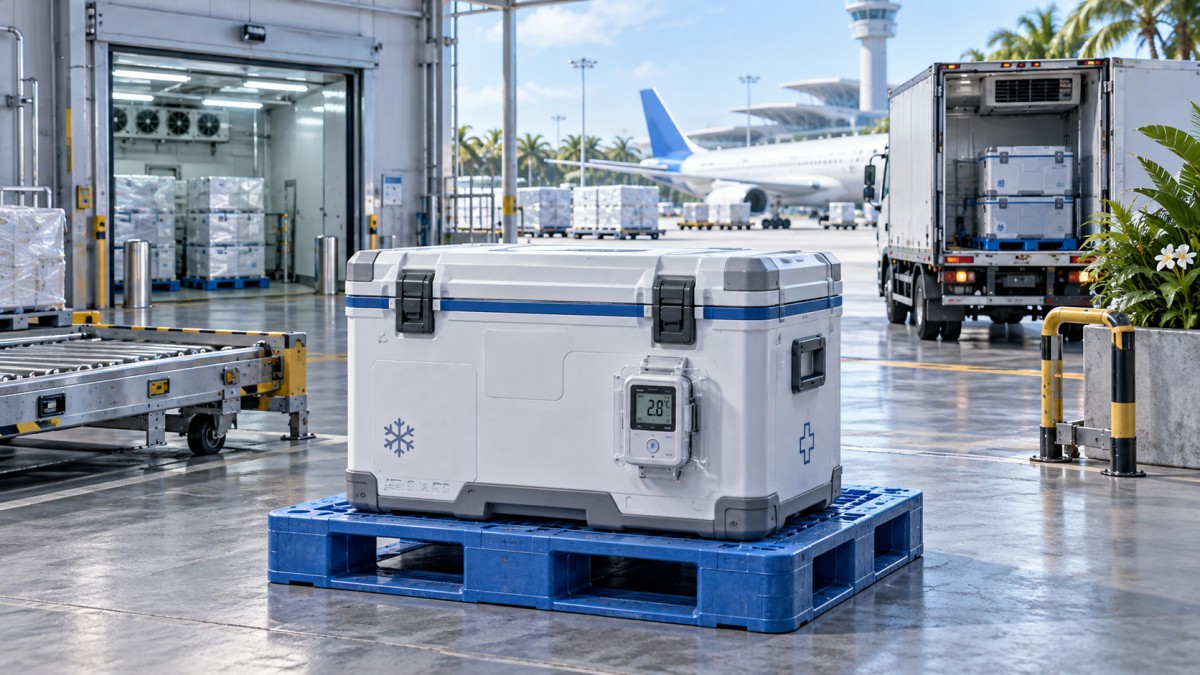
Border clearance creates a particularly important dependency because transport speed alone cannot control it. Documentation errors, permit issues, inspection requirements, or arrivals outside operating hours can extend the journey. Requirements differ by destination and product, so the project team should establish the applicable import process before shipment. Pre-shipment document checks, broker coordination, and confirmation of suitable storage during a hold can reduce exposure to an otherwise avoidable delay.
A useful planning exercise is to compare the expected journey with a disrupted journey. The disrupted scenario might include a missed flight, delayed release, or unavailable delivery vehicle. Compare both against the qualified packaging duration under relevant conditions. If the expected journey already consumes most of that duration, the route has little room for recovery. A faster nominal schedule will not compensate for the absence of a practical contingency.
Contingency arrangements need operating detail. “Move to cold storage” is incomplete unless the facility is identified, access is arranged, the required temperature capability is established, and someone has authority to release the shipment into its care. Replenishing coolant or opening a package may require a controlled procedure and trained personnel. An improvised intervention can introduce a new risk while attempting to address the original one.
The final delivery deserves the same scrutiny as international transport. A hospital or clinic may accept goods only during specific hours, have limited receiving capacity, or lack immediate access to suitable storage. Delivery completion should be tied to documented acceptance into the required conditions. Leaving a temperature-sensitive shipment at a receiving desk can turn an apparently successful transport movement into an unresolved quality event.
Visibility gaps make temperature control difficult to prove—and restore
A temperature logger can document exposure, but it cannot by itself prevent an excursion. If its data are read only after delivery, the quality team may discover a problem after the opportunity to intervene has passed. Real-time monitoring can support earlier action, provided communications coverage, alarm routing, and response responsibilities are effective along the route.
Monitoring design should distinguish between evidence needed for product disposition and information needed for operational intervention. Depending on the product, package, and qualification approach, useful records may include payload temperature, surrounding conditions, location, and handling events. Sensor placement matters: a reading from one location must be interpreted in relation to the package’s thermal behavior. A convenient sensor position is not necessarily representative of the product.
Fragmented systems are another source of uncertainty. A warehouse may record temperatures in its own platform, a carrier may use a separate system, and the receiving site may retain only a delivery note. Without linked timestamps and shipment identifiers, reconstructing an event becomes slow and ambiguous. Teams should define the records required at each handoff and how those records will be available to the quality function.
The monitoring and response plan should answer a few practical questions:
- Who receives an alert, including at night and during local holidays?
- Which conditions trigger intervention, and which require a quality hold?
- Who can instruct the carrier, arrange protected storage, or stop delivery?
- How are missing data, device failure, and communication outages handled?
- Who reviews the complete temperature history and authorizes product disposition?
Alerts should provide time to act where the monitoring system and product requirements allow it. A warning threshold may be set before a storage limit is reached, using an appropriate, justified approach. The response must then fit the route: contacting a driver is useful only if the driver has somewhere suitable to take the shipment and clear instructions on what may be changed.
When an excursion occurs, its significance depends on the product, temperature, duration, and available stability evidence. A brief deviation does not automatically establish that a medicine is unusable, and a normal reading at delivery does not establish that the preceding journey was acceptable. The designated quality function should assess the event through an approved process. Operational teams need a clear hold procedure so that uncertainty does not become accidental distribution.
Qualification gaps emerge when plans meet local operating conditions
A logistics provider’s broad capability statement is insufficient evidence for a specific biopharmaceutical route. Qualification should connect the product requirements to the facilities, packaging, vehicles, personnel, subcontractors, and receiving points that will perform the work. Particular attention is needed where a provider changes carriers or relies on local partners whose procedures and records may differ.
For project teams, the scope should be concrete enough to review. Identify the origin and destination, shipment size, product requirements, packaging configuration, expected duration, delay assumptions, monitoring method, and receiving arrangements. Assess representative operating conditions, including relevant hot-weather exposure and disruption scenarios. A successful movement under favorable conditions provides limited confidence about performance during a delay or a different handling pattern.
Useful evidence includes facility temperature mapping, equipment maintenance records, calibration arrangements, documented packout procedures, and training for personnel who handle temperature-sensitive shipments. Agreements should define responsibility for excursions, data retrieval, subcontractor oversight, and changes to the route. The evidence should match the proposed operation; a qualified warehouse does not establish that every vehicle or transfer process serving it is suitable.
Receiving-site readiness is frequently a separate workstream and should be included before launch. Confirm storage capability, available space, trained staff, shipment inspection procedures, and the response to a suspect delivery. A route can perform correctly up to arrival and still fail if the destination cannot place the medicine into appropriate storage promptly. This is especially consequential when expanding distribution to additional sites with different operating arrangements.
Project managers can turn these findings into a small set of launch conditions: sufficient temperature protection for the assessed journey, workable contingencies for vulnerable handoffs, accessible monitoring records, and assigned authority for intervention and quality decisions. Any unresolved gap should have an explicit operational consequence, such as restricting the destination, changing the delivery schedule, or selecting a different transport configuration. A risk register without those decisions offers little protection.
Cost comparisons should account for the full route. Lower freight or packaging costs may come with longer dwell times, additional transfers, or weaker recovery options. More expensive equipment may add little value if customs coordination or destination readiness remains the limiting factor. Investment is most useful when it addresses the stage that is likely to exhaust the shipment’s protection or prevent a timely response.
For biopharmaceutical projects in Southeast Asia, expansion should therefore proceed by qualified route and receiving capability. A new destination, carrier, package, or shipment configuration may change the assumptions that made the original route acceptable. Before adding volume, the project team should be able to explain where the shipment will wait during a disruption, how its condition will be known, and who will make the next decision while there is still time to protect it.
Related News
Get weekly intelligence in your inbox.
No noise. No sponsored content. Pure intelligence.
