



How Can I Update Precision Tool Component Specs Without Disruption?
How Can I Update Precision Tool Component Specs Without Disruption?
How do I update a component specification without disrupting production? For manufacturers working with precision tools, the practical answer is to treat the update as a controlled engineering change—not simply a revised drawing. Keep the existing configuration available where it remains acceptable, validate the proposed change, and define exactly when the new revision enters production.
Even a small adjustment to a tolerance, material, or surface finish can affect machining performance, supplier readiness, inspection methods, and assembly behavior. A change that looks harmless in CAD may require a different grinding operation or make an existing gauge unsuitable. Protecting throughput means finding those dependencies before releasing the specification, not discovering them at incoming inspection.
Zero disruption cannot always be guaranteed. A safety-related defect may require an immediate hold. For routine improvements, however, a staged transition can keep production moving without allowing unverified components into the process.
What should I check before changing the specification?
Start with the reason for the change. Are you correcting an ambiguous drawing, addressing premature wear, qualifying another supplier, or reducing unnecessary manufacturing cost? These are different problems and need different evidence. Tightening a tolerance because “precision is better” is not a sound requirement unless the tighter limit protects a functional need.
For a locating sleeve, for example, a diameter change may affect clearance, repeatability, and thermal behavior. For a toolholder component, changing the material or heat treatment can affect stiffness, distortion, or fatigue performance even when the nominal geometry stays unchanged. Assess the component in its working assembly, not only against its individual drawing.
Record the current requirement, proposed requirement, reason, and acceptance evidence in an engineering change request. Then trace the affected interfaces:
- Mating parts, fixtures, and assembly settings that depend on the changed feature.
- Machining, grinding, heat treatment, coating, or finishing operations that may need adjustment.
- Inspection equipment, measurement programs, and acceptance criteria.
- Purchased stock, work in progress, open purchase orders, and service spares.
- Customer requirements or approved configurations that limit your freedom to change.
The useful question is not “How many documents change?” It is “Where could this change create a mismatch?” A one-line drawing revision can still have a substantial production impact.
Can the old and new revisions remain in production together?
Sometimes, but coexistence needs an explicit interchangeability decision. Check whether either revision can replace the other without changing fit, function, assembly instructions, maintenance requirements, or customer acceptance. Matching external dimensions alone does not establish interchangeability.
If both revisions are approved for the same application, a controlled stock runout may be practical. If the new component requires a matching part or different setup, segregate the configurations and identify the permitted combinations. A separate part number may be appropriate when the components are not interchangeable; the decision should follow your configuration-management rules.
Avoid applying the new drawing retrospectively to old inventory without a documented disposition. Existing stock might remain usable under its original approval, require additional inspection, or need rework. If the change addresses an unsafe or unacceptable condition, continued use of the old revision may not be an option.
When should suppliers become involved?
Bring suppliers into the review before the revised specification is frozen. Ask for a manufacturability assessment and transition plan, rather than a simple acknowledgment that they received the drawing.
A precision machining supplier may accept a tighter tolerance but need different tooling, additional temperature control, or an extra finishing operation. A coating change may involve a subcontractor with its own lead time. Procurement needs to know whether these changes affect delivery commitments before engineering sets the effective date.
Useful supplier questions include: What stock has already been made? Which orders are in process? Can the existing route meet the new requirement reliably? Will new gauges or programs be needed? What evidence will accompany the first revised shipment? Also confirm who controls the change at any subcontracted operation.
For international sourcing, state material specifications, units, and technical conventions unambiguously. Do not assume a local material designation is equivalent to another market’s designation. Any proposed substitution needs review against the actual properties and application requirements.
This is where the cross-sector perspective used by The Global Industrial Perspective (GIP) is useful: a precision-tool revision can also be a supply-chain and logistics issue. Technical approval and delivery readiness need to move together.
What validation is enough before full production release?
Validation should match the failure risk and the scope of the change. A clarified note may need document review and confirmation that manufacturing practice remains unchanged. A material, fit, or heat-treatment change usually calls for physical evidence. There is no universal pilot quantity that proves every revision safe.
Use pilot components made through the intended production route wherever practical. A specially prepared sample may demonstrate that a supplier can make one good part, but not that its normal process can sustain the requirement.
Separate dimensional acceptance from functional acceptance. A component can pass inspection and still behave differently under clamping load, operating temperature, coolant exposure, or repeated cycling. Tests should address the mechanism the revision could affect. For a locating component, that might include repeatability after installation; for a sliding interface, it might include friction or wear under representative conditions.
Check the measurement system as well. A tighter tolerance is not useful if the inspection method cannot distinguish acceptable parts with sufficient confidence. Review measurement uncertainty, fixturing, temperature effects, and gauge suitability before interpreting results. Capability analysis also needs representative process data; a small prototype batch is not convincing evidence of long-term stability.
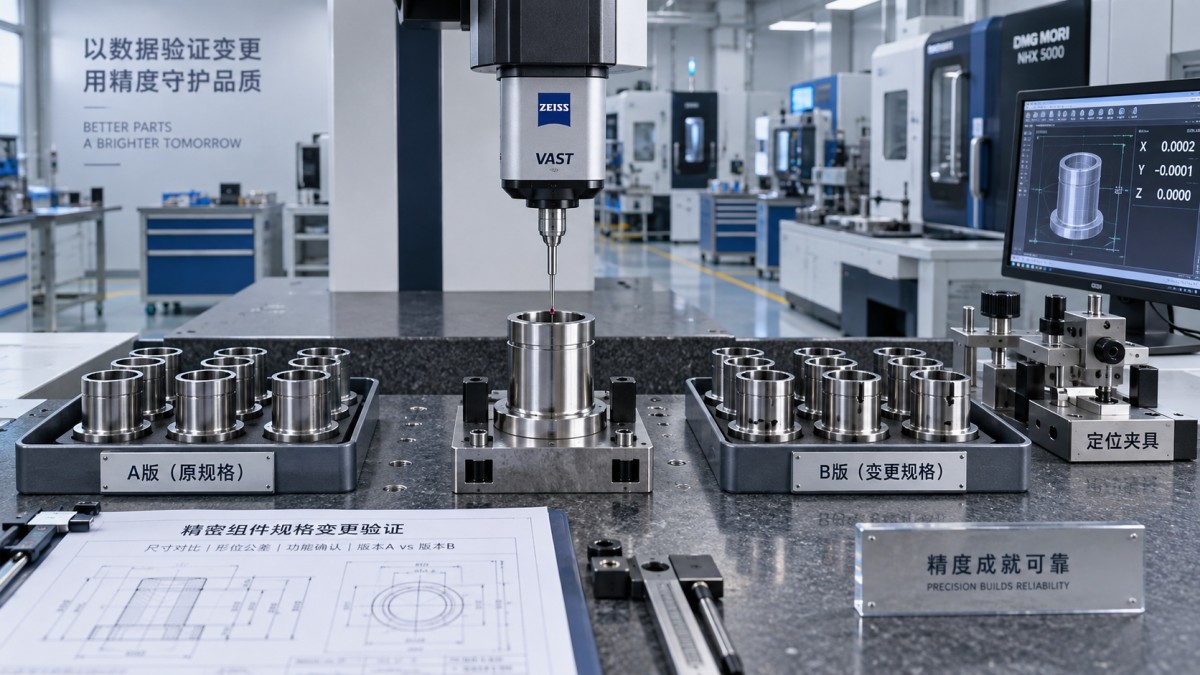
Define the release gates before the trial begins: supplier evidence accepted, critical characteristics verified, functional checks passed, and production documentation ready. Predetermined criteria reduce the temptation to approve a marginal result because a shipment is due.
How should I schedule the changeover?
Choose a traceable cutover point, not just a calendar date. Depending on the operation, this could be a work order, supplier lot, or equipment serial number. A date alone becomes ambiguous when deliveries arrive late or older stock remains beside the line.
A planned maintenance window or normal batch changeover may reduce additional downtime. Before committing, check whether the transition needs fixture changes, machine-program updates, revised offsets, or new inspection routines. Put those tasks into the production schedule instead of leaving them as informal actions.
A buffer of approved components can provide breathing room, but it should cover a defined transition risk. Excess inventory of the outgoing revision can become stranded if interchangeability assumptions prove wrong. Balance the buffer against validation timing, replenishment lead time, and the permitted use of old stock.
Assign a change owner to coordinate release status across engineering, quality, procurement, and production. That person need not make every technical decision, but someone must resolve conflicting readiness signals before the cutover.
Which documents and systems need updating?
The released drawing is only part of the change. Review the bill of materials, purchasing requirements, inspection plan, work instructions, routing, CNC programs, gauge records, and applicable service documentation. Update only what is affected, but make that assessment deliberate.
Whether the business uses integrated PLM and ERP software or a simpler controlled-document system, users need one authoritative release status. A correct engineering file does little good if a supplier receives an obsolete attachment or the shop floor follows an old printed setup sheet.
Specify how superseded versions are withdrawn from active use while retained for traceability. Ensure receiving inspection can identify which revision applies to each delivery. “Use the latest revision” is often too vague for orders spanning a transition; purchasing documents should identify the required revision or an equally clear configuration reference.
What if the component supports a regulated or customer-controlled product?
Do not assume internal engineering approval is sufficient. Components used in medical technology, pharmaceutical production equipment, or other controlled applications may be subject to customer notification, qualification, validation, or change-approval obligations. The requirements depend on the product, contract, jurisdiction, and applicable quality system.
Review those obligations before scheduling release. A seemingly modest finish change may affect cleaning performance, while a material change may alter corrosion resistance or compatibility. These are review triggers, not automatic conclusions that a particular regulatory submission is required.
What should happen if the revised component causes problems?
Agree on containment and rollback conditions before starting production. Define what triggers a hold, who can authorize it, and how affected assemblies will be traced. Warning signs might include unexpected assembly force, unstable inspection results, abnormal wear, or repeated setup adjustments.
Rollback is possible only if the previous configuration remains approved, compatible, and available. Preserve the necessary programs, fixtures, and documentation where appropriate. Do not revert automatically if the old revision was withdrawn for a safety or compliance reason; an alternative approved recovery route is needed.
For the initial production lots, monitor the characteristics most likely to reveal a transition problem. Include operator and assembly feedback alongside inspection records. Establish when enhanced monitoring can end based on evidence, rather than letting temporary checks become permanent without review.
Before releasing the revised specification, ask whether the team can identify the configuration of every affected component, explain why it is acceptable, and isolate it if something goes wrong. If those answers are unclear, the change is not yet ready—regardless of whether the drawing has been signed.
Related News
Get weekly intelligence in your inbox.
No noise. No sponsored content. Pure intelligence.
