



When does additive manufacturing cost less than injection molding?
Additive manufacturing costs less than injection molding when the cost of avoiding a mold, producing fewer parts, or accommodating design changes outweighs its higher production cost per accepted part. That can make it attractive for short runs, uncertain demand, customized products, and geometries that would otherwise require several molded components. Injection molding becomes more compelling when the design is stable, demand is sufficiently large, and tooling costs can be spread across repeat production.
There is no universal volume at which the answer changes. A small, simple component made in a modest tool has different economics from a large housing requiring complex tooling and extensive finishing. For finance approvers evaluating additive mfg, the useful question is: which process delivers the required quantity of qualified parts, over the relevant commercial period, at the lowest total cost and acceptable risk?
Start with equivalent parts and a defined demand horizon
A cost comparison only works if both manufacturing routes meet the same functional requirements. A printed component and an injection-molded component may share a drawing while differing in strength, surface finish, dimensional consistency, thermal performance, or behavior under sustained load. Those differences can affect qualification costs, rejection rates, and suitability for the application.
Material names alone do not establish equivalence. Polymer grade, processing conditions, build orientation, and post-processing can influence performance. If the printed route needs machining, sealing, coating, or additional inspection to meet the specification, those operations belong in its cost. If it cannot meet a mandatory requirement, a lower quotation does not make it a viable alternative.
Define demand over a period that matches the decision. This might be the launch phase, the expected life of a product revision, or the remaining service obligation for a replacement part. Comparing a molding investment against an optimistic lifetime forecast can make tooling look inexpensive even when the first design is likely to change before that volume arrives.
Also distinguish total demand from demand per design. A product family may have substantial aggregate volume but many variants, each requiring different tooling or changeovers. Conversely, interchangeable inserts or shared tooling may reduce the cost of molding those variants. The economics depend on how the parts can actually be manufactured, rather than on the combined sales forecast.
Calculate the crossover using total delivered cost
The basic comparison separates fixed costs from costs that increase with production. Injection molding carries an initial tooling commitment, along with relevant engineering, sampling, and qualification expenses. Additive manufacturing can require build preparation, fixtures, process development, and qualification even when it eliminates the production mold.
For a first screening calculation, use:
Total additive cost = additive fixed costs + quantity × additive cost per accepted part
Total molding cost = molding fixed costs + quantity × molding cost per accepted part
If molding has the higher fixed cost and additive has the higher variable cost, the simplified break-even quantity is:
Break-even quantity = (molding fixed costs − additive fixed costs) ÷ (additive cost per accepted part − molding cost per accepted part)
“Accepted part” matters. The denominator should include the cost of producing and delivering a component that passes the agreed inspection criteria. Material consumption, machine time, labor, finishing, inspection, and expected scrap should be reflected consistently. Comparing an unfinished print with a finished molded part will distort the result.
Consider an illustrative calculation using assumed figures, not market price benchmarks. Suppose molding requires $30,000 in fixed costs and costs $3 per accepted part. Additive requires $2,000 in fixed costs and costs $17 per accepted part. The $28,000 difference in fixed costs, divided by the $14 difference per part, gives a crossover at 2,000 parts.
At 500 parts, the modeled totals are $10,500 for additive and $31,500 for molding. At 5,000 parts, they become $87,000 and $45,000 respectively. The example shows why an attractive molding unit price can still produce the more expensive purchase at low volume.
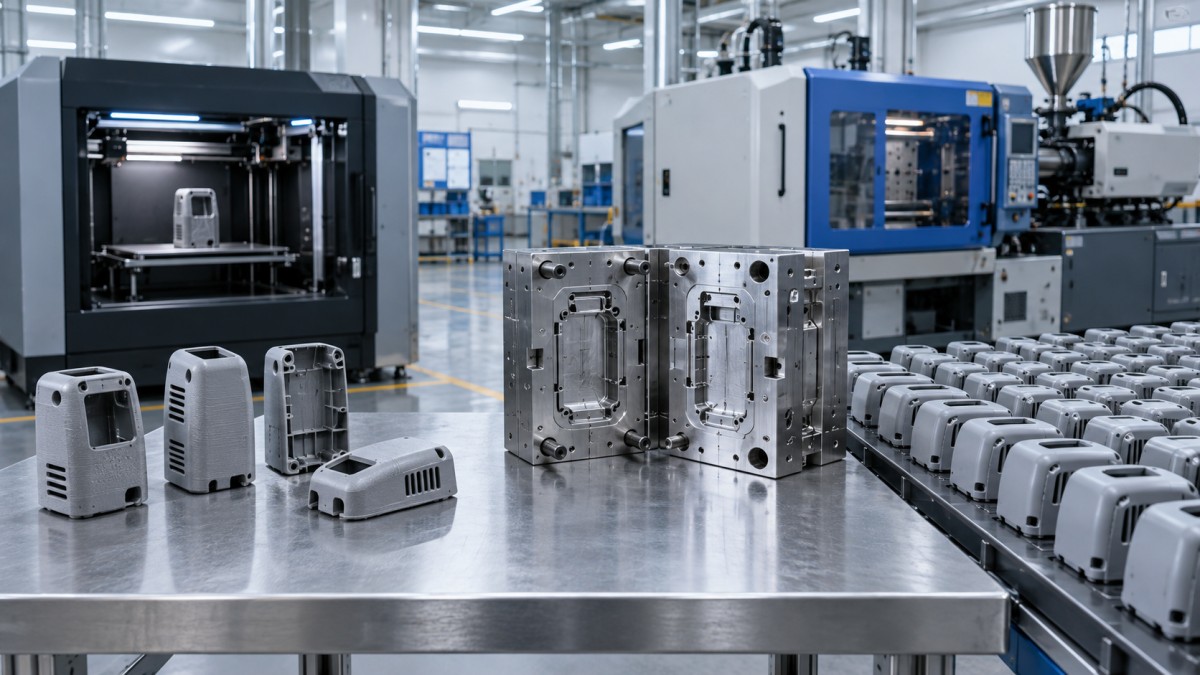
That crossover is a starting point. Supplier pricing may change with order size; additive build utilization may improve as parts are packed together; and molding costs may change with cavity count, cycle time, or tool configuration. Finishing and inspection can also have batch charges. Where these effects are material, compare quoted total costs at several volumes instead of extrapolating one unit price.
Cash timing deserves a separate view. A mold deposit paid before launch and additive purchases paid as demand arrives create different financing requirements. For a material investment extending over several years, use discounted cash flows with consistent payment timing. Keep this distinct from the operating cost comparison so that financing assumptions remain visible.
Where additive manufacturing can stay cheaper
Demand may never reach the tooling recovery point
Low volume is the clearest reason to consider additive, but demand uncertainty can be just as influential. A forecast above the calculated crossover does not guarantee that the mold will earn back its cost. Product cancellation, slower adoption, or a design revision can leave the investment spread across fewer saleable units than planned.
Finance should examine downside, base, and upside demand scenarios. The downside should reflect a credible commercial outcome, while the upside should include the cost and capacity needed to supply it. If additive remains affordable in the base case and limits exposure in the downside, its higher unit price may be justified during launch.
A staged route can preserve that flexibility: print early demand, then commission tooling after sales and design stability support the commitment. This approach has its own costs, including a second qualification effort and possible design adaptation. Include them when comparing staged production with molding from the outset.
The design is still changing
Additive manufacturing can reduce the financial consequences of changing geometry because it does not require a new production mold for every revision. That advantage is strongest when a change would otherwise require substantial tool modification or replacement. Small changes accommodated by an existing tool may offer much less benefit.
A revised print file still needs engineering control. Depending on the change, it may require new build preparation, inspection planning, functional testing, or customer approval. Budget those activities rather than treating every printed revision as free.
The relevant measure is the cost of supporting the expected revision pattern. Ask engineering which features are likely to change, whether the proposed mold can accommodate them, and how much existing inventory could become unusable. A stable component with a long production life gives molding a much stronger opportunity to recover its upfront cost.
Geometry removes other manufacturing expenses
Additive can be economical when its design freedom reduces the number of components, assembly operations, or tools needed for a functional product. Comparing one printed assembly with one molded component misses that advantage. Compare the complete function: all molded parts, purchased hardware, joining operations, inspection, and assembly yield.
Consolidation also creates tradeoffs. A single printed component may be harder to repair, clean, or inspect internally. A defect can cause the entire component to be rejected, whereas a modular assembly might permit replacement of one inexpensive piece. The cost saving must survive those practical requirements.
Complexity does not make printing automatically cheap. Supports, difficult powder removal, unfavorable orientation, long build times, and demanding finishing can increase costs. The strongest candidates are geometries that reduce downstream work while remaining efficient to print and qualify.
Production can follow actual consumption
Printing smaller quantities can reduce inventory exposure where molding requires larger economic batches or minimum orders. This can matter for slow-moving replacement parts and variant-heavy products. Evaluate storage, financing, handling, and potential write-offs alongside production expense.
Use consistent inventory accounting. If the model already charges the full cost of purchased parts, adding their full value again as an obsolescence expense would double-count the purchase. Show the cash committed to the batch, the quantity expected to be consumed, and any residual inventory value separately.
On-demand production also needs credible delivery capacity. If service commitments require immediate availability, some stock may still be necessary. A digital design file provides no assurance that a qualified machine, suitable material, and finishing capacity will be available when the order arrives.
Costs that can reverse an apparent additive advantage
Post-processing is a frequent source of incomplete comparisons. Support removal, cleaning, curing, machining, surface treatment, and dimensional inspection can add labor and extend delivery time. Their importance varies by process and specification, so a supplier should identify which operations are included in the quoted price.
Yield assumptions also deserve scrutiny. A quotation based on successful builds may exclude the effect of failures or rejected parts. Ask who pays for replacement production and whether the supplier’s commitment covers delivered conforming parts. For either process, expected yield should be supported by relevant production evidence when available.
Capacity changes the calculation further. An additive supplier may offer an attractive price for a small batch without being able to maintain that price and delivery schedule at sustained demand. Additional builds, machines, shifts, or finishing labor can alter the economics. Molding likewise needs sufficient press capacity and a tool capable of supporting the required output.
For an internal additive investment, avoid comparing raw material cost with an outsourced molding price. Ownership brings equipment, maintenance, labor, facilities, software, and utilization assumptions into the model. A machine running below planned utilization spreads its costs across fewer parts. Outsourcing can avoid that commitment, although supplier margin and purchasing conditions remain part of the price.
Existing assets require a different treatment. If a suitable mold already exists, its historical purchase cost is generally sunk for the next production decision. Compare the future costs that each option would actually cause, including refurbishment, transfer, maintenance, or capacity constraints. Additive loses much of its tooling advantage when no new mold investment is needed.
What a finance approval should establish
A useful approval package gives both suppliers the same requirements and asks for costs at several credible demand levels. It should make the following assumptions explicit:
- Qualified output: material requirements, tolerances, finish, testing, and inspection needed for acceptance.
- Fixed commitments: tooling, engineering, qualification, deposits, ownership rights, and relevant modification costs.
- Recurring costs: delivered part prices, batch charges, finishing, inspection, freight, and responsibility for rejects.
- Commercial exposure: minimum orders, payment timing, inventory assumptions, and the consequences of a design change.
- Capacity: lead times and achievable output at the volumes used in the financial model.
Separate the production decision from the equipment ownership decision. Buying printed parts for a launch may be economical without justifying the purchase of a printer. Similarly, owning a mold does not necessarily require owning a molding press. Evaluate the commitments each purchasing arrangement creates.
Where a staged approach is appropriate, set a review trigger before approving it. That could be confirmed demand, completion of design validation, or a cumulative quantity at which tooling becomes financially attractive. Allow for the time required to build and qualify the mold; waiting until the crossover has already been reached may prolong expensive bridge production.
Additive manufacturing costs less when the expenses it avoids exceed the additional cost of making each accepted part. Approval should rest on a credible demand horizon, comparable specifications, and a cost model that includes the work needed to deliver usable components. When molding wins only under an optimistic forecast, retaining flexibility has value. When committed demand comfortably supports tooling recovery and the design is stable, the lower recurring cost of molding becomes a stronger basis for investment.
Related News
Get weekly intelligence in your inbox.
No noise. No sponsored content. Pure intelligence.
