



How demand volatility should shape a manufacturing investment strategy
A factory expansion can look justified when the order book is full, yet become a cash-flow burden when customers postpone deliveries. The opposite problem is equally costly: a business delays investment, demand rises, and constrained production forces it to reject orders or rely on expensive emergency outsourcing. Demand volatility should therefore change not only how much a manufacturer invests, but also the timing, reversibility, and operating flexibility of that investment.
A resilient manufacturing investment strategy commits permanent capital to demand that remains credible under downside conditions, then uses staged or flexible capacity for uncertain growth. The decision should rest on demand quality, bottleneck capacity, downside cash flow, and the cost of responding too slowly—not a single sales forecast or a headline equipment payback period.
Separate durable demand from a temporary order surge
Before approving capacity, establish what the order book actually represents. Increased orders may reflect sustained end-market consumption, but they may also come from customer inventory rebuilding, duplicate purchasing during shortages, promotional activity, or orders pulled forward before a price change. These patterns create very different investment requirements.
Review demand at the product-family and customer level rather than relying on total revenue. A stable aggregate forecast can conceal a declining legacy product and rapid growth in a new product that uses different tooling, materials, or inspection processes. Extra capacity on the wrong production route does not solve the emerging constraint.
- Order firmness: Distinguish enforceable commitments from forecasts, cancellable purchase orders, and early-stage sales opportunities. Examine cancellation rights and delivery rescheduling terms.
- Customer concentration: Identify whether growth depends on one buyer, launch program, or procurement cycle. Multiple customers exposed to the same end market may not provide genuine diversification.
- Consumption versus stocking: Compare shipments with available customer usage or inventory information. An order increase without matching consumption may reverse quickly.
- Product life and qualification: Check whether the expected demand window is long enough to recover the investment, including ramp-up and customer approval time.
The output should be a demand baseline that management can defend, plus a separate layer of uncertain upside. Do not treat all backlog as equally investable simply because it appears in the same planning system.
Translate uncertainty into capacity scenarios
A base-case forecast is useful for scheduling, but insufficient for an irreversible capital decision. Build a downside, expected, and upside scenario with explicit assumptions about order volume, product mix, selling prices, delivery timing, and customer retention. Where probabilities cannot be defended, compare outcomes without inventing precise likelihoods.
Each scenario should show required production hours at the actual constraint. Rated equipment output is not saleable capacity. Changeovers, maintenance, scrap, staffing gaps, inspection, and material availability reduce usable output. Product mix matters because different items can consume very different amounts of bottleneck time.
Map the production route from incoming materials through final release. An additional machining center may add little shipment capacity if heat treatment or inspection is already saturated. Conversely, a targeted investment in fixtures, maintenance, or quality control may release capacity without a major expansion.
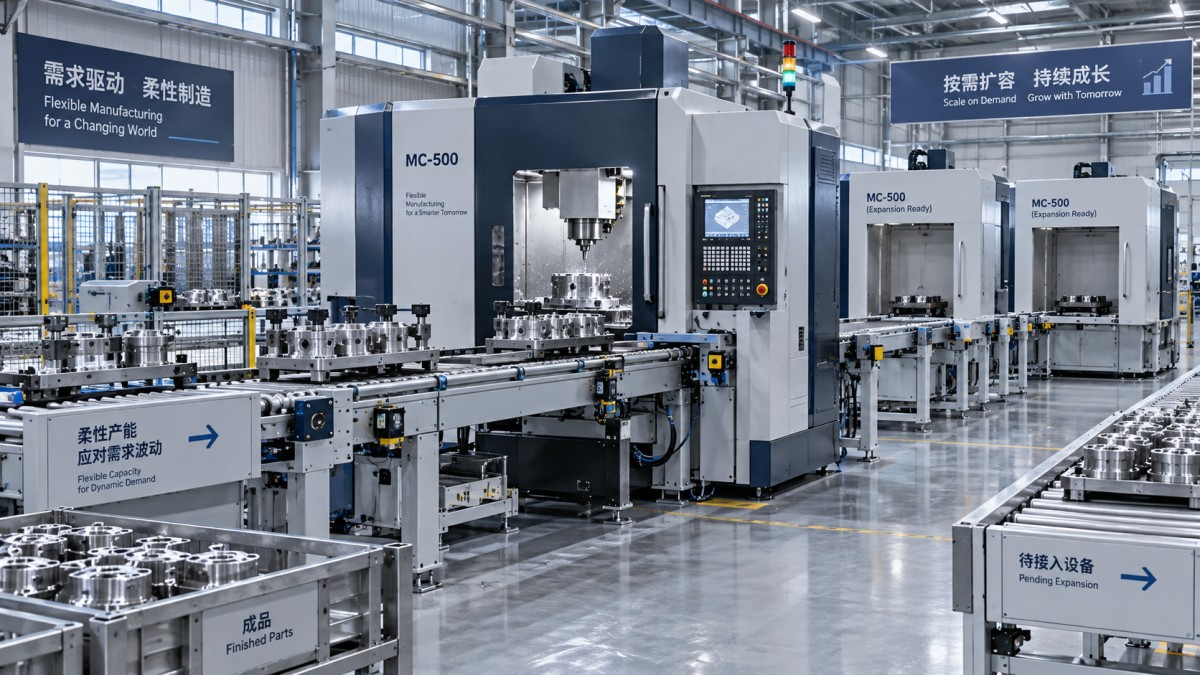
Capacity buffers should reflect the consequences of shortage. A business with long customer qualification cycles and strict delivery obligations may need more reserve capacity than one able to adjust lead times. However, reserve capacity is useful only when labor, materials, and supporting processes can activate it.
Make the financial case survive lower utilization
Equipment quotations capture only part of the commitment. The investment model should include installation, utilities, building modifications, tooling, software integration, training, validation, commissioning losses, maintenance, and working capital. Expanded output can absorb cash before customers pay, particularly when additional inventory or longer receivable terms accompany growth.
Calculate net present value and cash requirements across the demand scenarios. Use contribution margin after genuinely volume-dependent costs, then account separately for incremental fixed costs. Avoid treating allocated overhead savings as cash savings unless the underlying expenditure will actually disappear.
Break-even saleable volume = incremental annual fixed cash costs ÷ contribution per saleable unit.
This operating break-even calculation is a screening tool, not a complete investment test. It excludes the recovery of initial capital, financing effects, taxes, and timing. For mixed products, use weighted contribution and bottleneck hours rather than assuming every unit has the same economics.
The downside case should reveal whether the business can support debt service, maintenance, and working capital when utilization falls. Stress-test a slower ramp-up alongside weaker demand; these risks can occur together. A project that remains profitable on paper may still create an unacceptable liquidity gap.
Also price the cost of not investing: rejected contribution, expedite costs, deteriorating service, or the risk of losing a qualified customer position. Do not assume every delayed order becomes a permanent lost sale. The comparison needs evidence about customer alternatives and delivery tolerance.
Compare flexibility with its full operating cost
Flexible capacity is not automatically cheaper. Its value lies in reducing the financial consequences of being wrong about demand. Procurement should compare alternatives over the same demand scenarios, including quality, lead time, integration, and exit costs.
Dedicated equipment versus reconfigurable production
Dedicated equipment can offer strong throughput and attractive unit economics when product design and volume are stable. It becomes riskier when tooling has limited reuse or a customer can change specifications before the asset earns its return.
Reconfigurable equipment may sacrifice some peak efficiency while allowing production to shift across products. Evaluate changeover duration, achievable tolerances, tooling cost, programming effort, and operator requirements. A machine advertised as flexible is not commercially flexible if every product change requires lengthy validation or costly engineering.
Ownership, leasing, and external capacity
Leasing can reduce upfront cash requirements, but it does not necessarily make capacity easy to exit. Minimum terms, termination charges, maintenance obligations, and return conditions may preserve much of the downside exposure. Compare total contractual commitments, not just monthly payments.
Contract manufacturing can serve as a bridge while demand becomes clearer. Its suitability depends on supplier availability, quality controls, intellectual property exposure, transport time, and the ability to secure capacity during market-wide peaks. An unqualified supplier is not a dependable contingency.
Additional shifts can be attractive when existing equipment has unused hours, although labor availability, supervision, fatigue controls, and maintenance access may limit the option. Use sustained achievable output, not a short burst of overtime performance, when comparing shifts with new machinery.
Phase spending around evidence, not calendar dates
Staged capital spending works when each phase buys useful capacity or preserves a valuable expansion option. It works poorly when a nominally small first purchase requires the entire supporting infrastructure immediately.
Break the project into commitments with clear dependencies: site preparation, utilities, equipment orders, tooling, recruitment, and customer qualification. Identify which decisions are reversible and which create substantial cancellation costs. The last practical point for postponement may occur before delivery, when engineering or fabrication begins.
- Resolve the present constraint. Confirm whether process improvement, maintenance, or a limited debottlenecking purchase can meet validated demand.
- Prepare the next increment. Reserve space and assess utilities, supplier lead times, and expansion interfaces without prematurely purchasing every asset.
- Set release conditions. Tie further spending to sustained qualified orders, verified bottleneck loading, acceptable downside economics, and available liquidity.
- Define pause conditions. Specify what happens when cancellations rise, a major launch slips, qualification fails, or the cash forecast deteriorates.
Triggers should combine commercial and operational evidence. High utilization alone may reflect downtime or an unfavorable mix rather than durable demand. Strong sales forecasts alone may not justify expansion if the new process has not demonstrated yield and cycle time.
Waiting also has a cost. Long equipment lead times or scarce installation resources may justify ordering earlier, especially when customer commitments are firm. In that situation, negotiate staged payments, cancellation provisions, or delivery flexibility where available, and evaluate their price against the risk they reduce.
Procurement terms can determine whether flexibility is real
A technically suitable asset can still create excessive commercial exposure. Ask suppliers to distinguish demonstrated capability from optional upgrades and future promises. Acceptance criteria should cover the relevant product mix, cycle time, quality, changeover requirements, and integration responsibilities—not merely whether the machine powers on.
Review service coverage, spare-parts availability, software licensing, relocation restrictions, and the cost of expanding later. Proprietary interfaces can make a modular production plan dependent on one supplier. Expansion pricing and compatibility deserve attention before the initial purchase, when negotiating leverage is greater.
Where qualification is necessary, include its duration and cost in the investment schedule. Regulated or customer-controlled processes may require approval after equipment relocation, supplier changes, or significant process modifications. These requirements can restrict the apparent flexibility of leasing, outsourcing, or redeployment.
Set decision rules before demand changes again
The approval document should record the demand assumptions that justify spending, the capacity constraint being addressed, and the response if those assumptions fail. Assign responsibility for monitoring customer commitments, product mix, effective capacity, and liquidity. Review these signals through the existing sales and operations planning process, with exception reviews for material changes.
Proceed with dedicated expansion when demand is sufficiently durable, the constraint is verified, and downside cash flow remains tolerable. Prefer staged or redeployable capacity when growth is plausible but timing or mix remains uncertain. Defer a project when its economics depend on uninterrupted peak utilization and no credible fallback use exists.
A demand decline after approval should trigger reassessment of remaining commitments, not automatic continuation because money has already been spent. Compare the future cost and value of completing, pausing, resizing, or cancelling the project. Sunk expenditure does not make the next purchase economically justified.
Related News
Get weekly intelligence in your inbox.
No noise. No sponsored content. Pure intelligence.
